
Explore your next steps
Your guide to guitar lessons in London
Choose an instrument, plan your practice and find a lesson format that works for you.
01
Getting started
Guitar lessons in London: find your starting point
You do not need a detailed learning plan before contacting a guitar teacher. Think about the songs, sounds or players that made you want to pick up the instrument. Perhaps you want to accompany your singing, understand a favourite riff or feel more comfortable joining other musicians. Tell me what you have tried and what you would like to do next. We can use that conversation to choose a practical starting point, whether you are a complete beginner or returning after a break.
Your first lesson: start guitar lessons in Camden
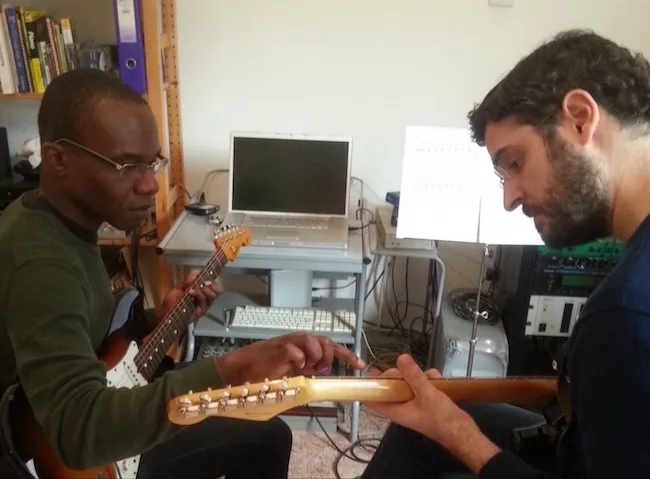
Most lessons take place at my teaching space on Arlington Road in Camden, near Camden Town Underground station. You receive the full address when booking. There are guitars and equipment available, so let me know if bringing your instrument is inconvenient. You do not need to prepare a performance. If you already play, a short example can help us identify a useful focus. Include any access requirements in your enquiry so we can discuss the arrangements before your visit.
Choose a manageable routine
Studio lessons cost £20 for 30 minutes or £30 for an hour. Weekly and fortnightly appointments are available, with other arrangements by agreement. Consider both the lesson and the time you can give to practising between sessions. A shorter lesson may be a useful starting point for a child, while a longer session allows more time to work through ideas. I welcome learners from age five and adult learners. Taking guitar lessons can fit around work or family life; choose a routine you can sustain over the next few months. Tell me the learner’s age, interests and experience when asking about availability.
Guitar learning for children and adults
Guitar education can begin at different stages of life. For a child, choose a manageable instrument and a short task they can explain and try again at home. A parent can help make time for practice without turning every attempt into a test. For an adult returning after years away, begin with what you remember and one musical goal. You do not need to follow a fixed course or learn every technique before enjoying a song. Tell me how you prefer to learn: hearing a demonstration, breaking a movement into smaller steps or connecting an idea with written notes. We can use that conversation to make the lesson easier to follow.
Choosing a guitar teacher
A good teacher listens to what you want to achieve and explains a task in a way you can try for yourself. Ask about the music, lesson format and practice support before booking. An encouraging teacher should help you recognise a small improvement as well as a difficulty. My London guitar lessons are individual sessions: you can ask questions and revisit an idea at your own pace, rather than following the pace of group guitar classes. Tell me about any previous guitar learning experience, including what helped and what felt confusing.
02
Instruments & styles
Acoustic guitar and songs
Acoustic guitar offers ways to explore rhythm, melody and accompaniment without needing an amplifier. A simple song can introduce chord changes, while a fingerpicked pattern helps you listen to individual notes and their balance. The right starting point depends on your interests and experience. Before buying, choose an instrument you feel comfortable holding and playing as you learn to play guitar. If you are unsure, ask for advice and try suitable instruments where possible. You can use a studio guitar initially while thinking about what you need for regular practice.
Electric guitar and control of sound
Electric guitar provides a wide range of sounds, but a useful first task is listening carefully to the notes you make. A short riff can reveal uneven timing or an extra string ringing. Work slowly enough to notice these details before adding speed or effects. In lessons we can explore riffs, solos, bends and phrasing at an appropriate level. When planning an electric setup, remember that the guitar is only one part: you also need a suitable way to hear it, alongside basic accessories such as a cable and tuner.
Explore styles without losing your focus
My teaching spans genres including folk, rock, pop, jazz, soul and funk. If jazz guitar interests you, bring a recording so we can connect the harmony and phrasing to a practical exercise. You might focus on one style or borrow an idea from another to develop your playing. Listen to what the guitar is doing in a recording: supporting a singer, creating a rhythmic pattern or answering a melody. That gives you a more specific question than simply wanting to play better. Bring an example to a lesson and we can explore a manageable part of it, rather than trying to learn every technique at once.
Acoustic, electric or classical guitar?
A steel-string acoustic guitar, an electric guitar and a nylon-string classical guitar feel and sound different. The label alone does not tell you how comfortable an instrument will be: neck shape, size and setup matter too. Try holding a few instruments and listen to their sound before choosing. My tuition covers acoustic and electric playing; discuss your preferred music and instrument with me before buying. You do not need an expensive guitar to begin, and a suitable studio guitar is available for your lesson.
03
Practice & progress
Make barre chords and chord changes clearer
Choose a task small enough to hear and evaluate. That could be changing between two chords without interrupting the rhythm or playing a short phrase with clear notes. For barre chords, check the notes individually before trying the change in a song. Play it, pause and notice what changed. If the same difficulty persists, write down what happens and bring the question to your next lesson. Repeating a whole song can be enjoyable, but isolating the difficult moment often makes practice easier to direct. Return to the song afterwards so the exercise remains connected to the music you want to play.
Keep the rhythm moving
A chord change is a musical event, not only a finger shape. Begin at a pace where you can keep a steady pulse, simplifying the strumming pattern if necessary. Listen for where the change falls in the song and try counting that section. When the movement becomes easier, build the pattern back gradually. A recording can show how the part fits with the other instruments, but you do not have to match its full speed immediately. We can adapt the task in lessons when it feels too difficult or too familiar.
Connect music theory with what you hear
Music theory is most useful when it helps explain a musical question. A chord progression can introduce how chords relate; a short melody can help you find notes on the fretboard. You do not need every term at once, and the amount of theory in lessons can follow your interests. Try applying one idea to a song or a small improvisation. Hearing how it works makes it easier to remember and gives you something concrete to ask about when an explanation does not yet make sense.
Build practice into everyday life
Try a short, regular practice session that fits your day. Ten focused minutes can be a manageable starting point: tune up, revisit one exercise and finish with music you enjoy. Keep your guitar safely accessible so getting started is easy. Note one question for the next lesson, and compare your playing with an earlier recording rather than another guitarist’s finished performance. Adult learners can fit practice around work and family commitments; teaching adults starts with understanding that available time varies. A sustainable routine is more useful than an ambitious plan you cannot keep.
04
Develop your guitar playing
Advanced guitarists: look beyond speed
Progress as a guitar player may mean a chord sounds clearer, a bend reaches its intended note or a phrase has more shape. Choose a musical detail you can hear rather than measuring every session by speed. Advanced players and developing guitarists can work on improvisation, composition, tone and expression. Bring a recording, a song idea or a passage that illustrates your goal. We can identify the part that needs attention and develop an exercise with a clear purpose, then return to the music to hear whether it helps.
Prepare for playing with others
Playing alongside another musician brings attention to timing, listening and leaving space. You may need to simplify a guitar part so it supports the song rather than competing with it. Learn the structure, notice the transitions and practise entering after a pause. For performance or recording, consistency can matter as much as a difficult passage. Lessons can explore stage performance and recording-related playing, using your own musical goals to decide what to work on. Tell me about an upcoming project so we can discuss useful preparation.
Gift vouchers for guitar lessons
Gift vouchers are available. Ask about the lesson format, voucher value, validity and booking arrangements before purchasing, so the recipient knows how to get started.
Choose your next step
Your interests can change as you discover another artist or begin writing music. Music lessons can give you space to test ideas and ask for practical tips. Lessons can respond to those changes while keeping a practical focus. Most tuition is at my Camden teaching space; a limited number of mobile lessons may be available for an additional travel charge. To enquire, send your musical interests, experience and preferred times, plus your area if you want a possible home visit. We can discuss availability, the appropriate lesson length and the arrangements before you book.
Turn listening into songwriting ideas
Listen to a short passage and describe what catches your ear: a blues phrase, the space between chords or a change in dynamics. Try varying one element of your own idea while keeping the rest simple. In songwriting, a repeated rhythm can give a melody a clear setting; improvisation lets you test alternatives before choosing one. Record a small sketch and return to it later. You can bring that sketch to a lesson so we can connect music theory, technique and the sound you want to create.
Explore London’s music scene
Read our guitar shop guide, discover London music venues or plan a session with our rehearsal and recording guide. The guitar article library has more ideas for your playing.